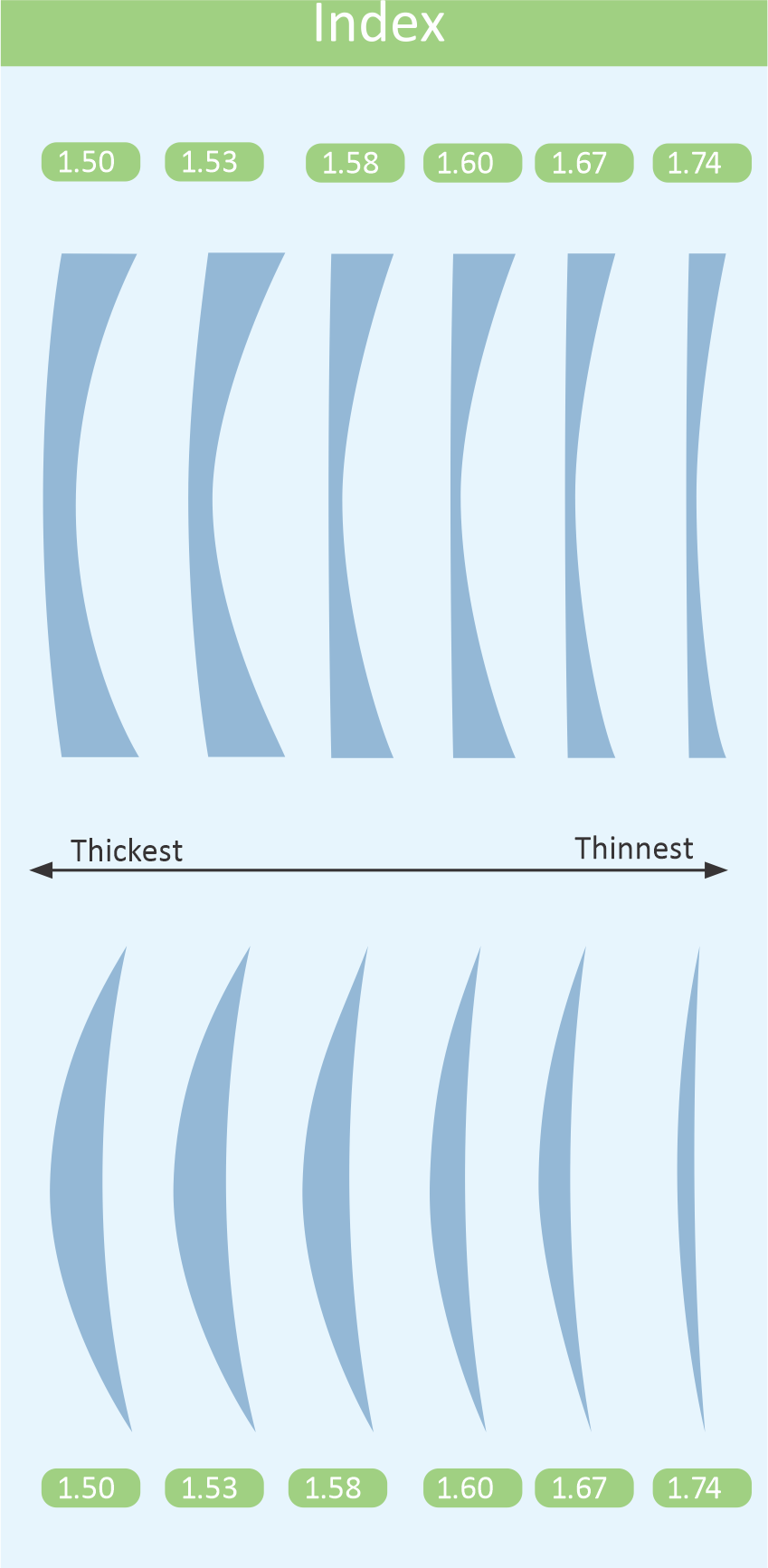
What is “Lens Index”?
When dispensers talk about the “index” of a pair of prescription lenses, that’s shorthand for the “Index of Refraction”. The index of refraction is the degree to which light is bent as it passes through a material. That’s very important for glasses, because the higher the index of refraction, the thinner the lenses can be made.
Does that mean higher is better?
Not necessarily. Higher index lenses are thinner, but low prescriptions are already thin, so they don’t benefit from high index lenses. Also, in general, the higher the index of refraction, the worse the optics of the lens will be. Every lens material also has different physical properties, such as impact resistance, tintability, and tensile strength.
As an added complication, not every lens manufacturer uses the same type of lens material for any given index. There are, for example, many different optical materials that are 1.6 index. Some of them provide excellent optical quality; some do not. At Prairie, we only use the highest quality lens materials.
What are my choices?
Lens index choices vary from company to company. We offer the following at Prairie: 1.5, 1.53, 1.58, 1.59, 1.6, 1.67, and 1.74.
Here is a summary of the strengths and weaknesses of each, and an approximate prescription range for each material:
1.5 index (CR-39):
Used for prescriptions +3.00 to -3.00
Pros: Best optical quality, cheapest, tints very well
Cons: Thickest lenses, chips more easily than other materials, low impact resistance
1.53 index (Trivex):
Used for prescriptions +3.00 to -3.00
Pros: Much lighter than CR-39 (lower density), good optical quality, excellent impact resistance, excellent tensile strength (good for rimless frames). Is CSA approved for safety glasses
Cons: Not tintable, almost as thick as CR-39, somewhat expensive
1.58 index (Quatrex/Quattro Impact):
Use for prescriptions +4.00 to -6.00
Pros: Second best optical quality, lightweight, impact resistant, tints very well, good impact resistance, excellent tensile strength
Cons: Only available in clear and clear blue blocking lenses. No transitions or polarized
1.59 index (Polycarbonate):
Use for prescriptions +4.00 to -6.00
Pros: Relatively thin, excellent impact resistance, lightweight (low density), CSA approved for safety glasses
Cons: Poor optical quality, low tensile strength (not recommended for rimless frames or drillmount), poor chemical resistance
1.6 index (MR-8):
Use for prescriptions +5.00 to -6.00
Pros: Relatively thin, good optical quality, moderate impact resistance, good tensile strength, tintable
Cons: More expensive than CR-39
1.67 index (MR-10):
Use for prescriptions +6.50 to -9.00
Pros: Thin, moderate tensile strength, somewhat tintable
Cons: Mediocre optical quality, more expensive
1.74 index (MR174):
Use only for prescriptions higher than +6.50 or -9.00
Pros: Thin
Cons: Very expensive, poor optical quality, high density, poor coating adhesion (coatings more likely to craze or peel), poor tensile strength, poor impact resistance, tints poorly
What does all of that mean for me?
For most people, either Quatrex or 1.6 index MR-8 are the best choice. These materials provide thinner, lighter lenses that are more suitable for rimless frames, all without the significant extra expense of higher index materials.
As your prescription increases, you might need to move to higher index materials. You could start out in a 1.6 index lens, and need to progress to a 1.67 index lens as your prescription worsens. 1.6 provides a better all-around experience than 1.67, but the decrease in thickness 1.67 provides is well worth it for people with higher prescriptions.
1.74 index should only be used if you have a very high prescription. While it’s an excellent option for those with very high prescriptions - and thus very thick lenses - most people would be better served with a lower index material that is both cheaper and has better optical and physical properties.